Dear Friends of SJV,
Greetings to each of you as we prepare to enter the Sacred Triduum. Our seminarians have gone to each of their home dioceses to participate in the liturgies of this week, and then they will have a break to celebrate the Easter Octave with their families.
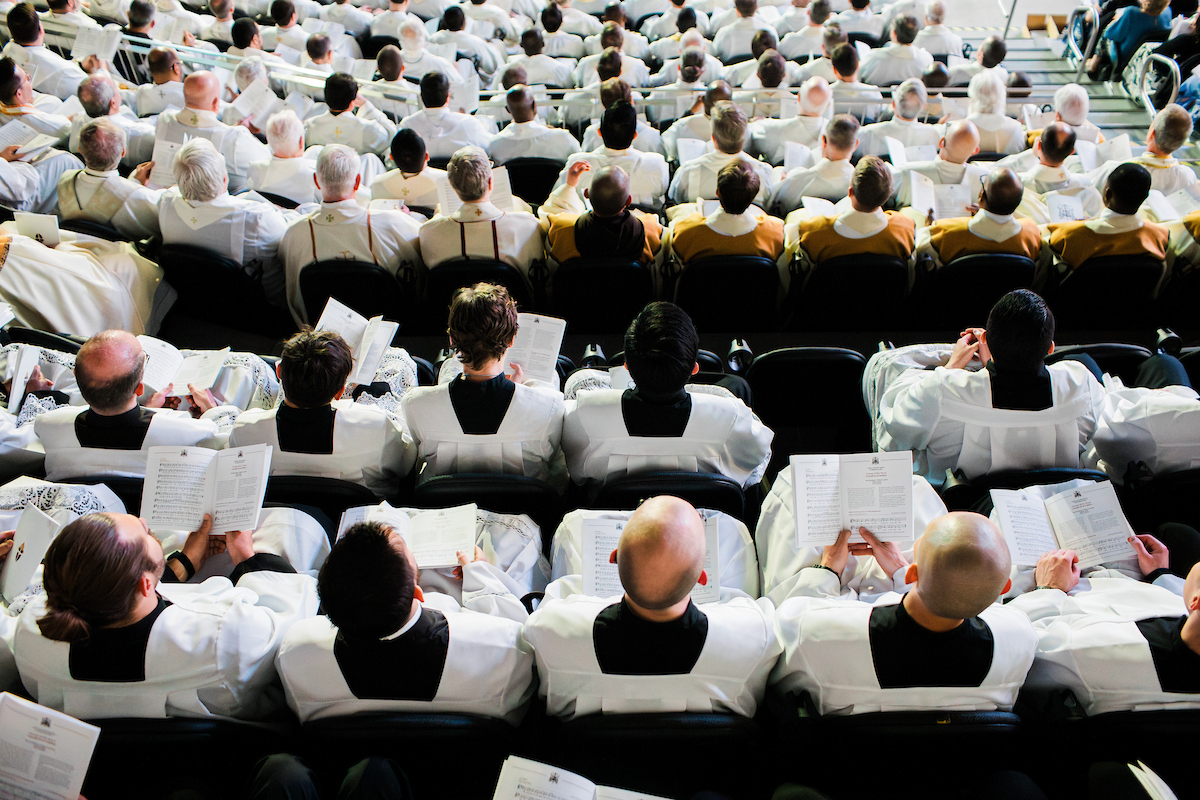
Last week was quite busy as we welcomed our new Archbishop James R. Golka with Solemn Vespers on Tuesday, the Installation Mass on Wednesday, and another Mass on Thursday for Archbishop Golka to take possession of the Cathedra. It was a week of blessings as our seminarians served at the liturgies to welcome our new shepherd and spiritual father. It was a beautiful moment as he expressed his fatherly love to us. We now have the opportunity, as a seminary, to answer with an expression of our filial docility and love for him as well.
This month, we will hear from Father Daniel Eusterman, my assistant and the house-father at Our Lady of Lourdes parish house. He has worked hard and shared his gifts, particularly those of woodworking, to transform the chapel at the Lourdes House.
Next, we have an article by Dan Igoe, who shares about the beauty and catechetical function of stained-glass windows. You will see below his own talent for this traditional art form.
I pray for each of you to have a blessed Holy Week and a glorious celebration of the Resurrection of Our Lord!
In Christ,
Fr. Ángel Pérez-López
Photos provided by Grant Whitty with Denver Catholic
From the Beautiful to the Beautiful One
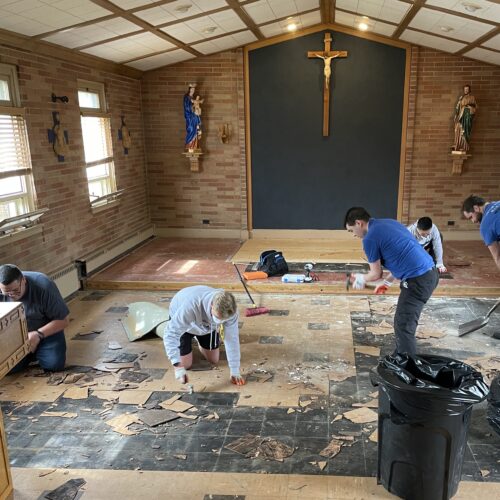
The Our Lady of Lourdes chapel during the deconstruction phase.
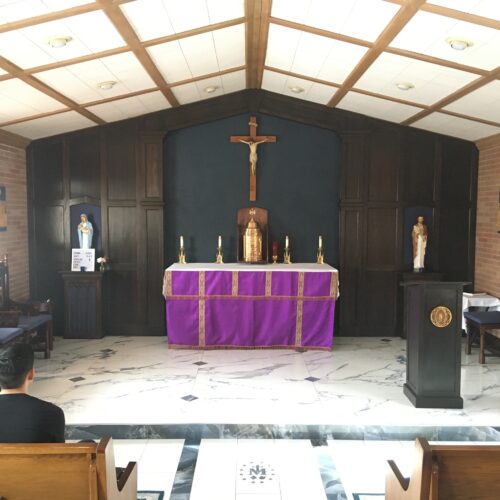
This photo of completed chapel features the skilled woodworking of Father Daniel Eusterman.
Here at SJV, we have six different “parish houses” where the seminarians live, pray, study, and recreate in smaller communities. The house where I serve, Our Lady of Lourdes parish house, was built in 1955 as the convent for the Sisters of St. Francis of Perpetual Adoration, who taught at the parish school. After the sisters left in the 80’s, the convent changed hands a few more times, and then, in the 2000’s, became our parish house.
Since my assignment to “Lourdes House,” our household has been gradually continuing the prior house father’s work of updating the various areas of the convent. The main work has been at the heart of the house: the St. Maximilian Kolbe Chapel, where the Franciscan sisters spent decades in perpetual adoration. It was the community’s clear desire that the chapel, simple and prayerful, needed some updating to make it a more beautiful place for daily Eucharistic Adoration and for the Liturgy of the Hours.
We desired that the chapel be gently remodeled to lead us daily “to the increase God’s praise and of his glory” by means of “turning men’s minds devoutly toward God” (SC 122). With the seminarians’ labor (mostly in deconstruction), the chapel underwent several renovations: replacing old carpets with tile, reupholstering pews, and adding new woodwork to the sanctuary. The space has been transformed by “the work of human hands” and has become, even more, a place where beauty draws us daily to the adoration, praise, and glorification of God.
Fr. Daniel Eusterman
Our Lady of Lourdes Formation Advisor
St. John Vianney Theological Seminary
Window to God
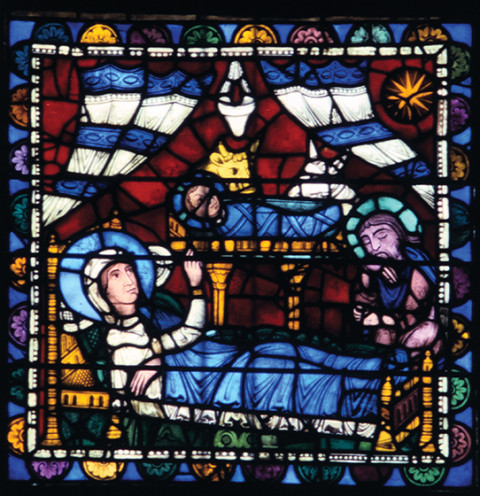
The Nativity stained glass window in the Cathedral of Notre Dame in Chartres, France.
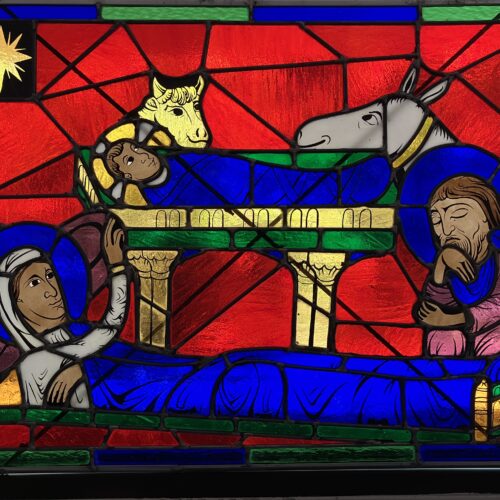
Dan Igoe’s lovely rendition of the Nativity window.
Baby Jesus. The Blessed Virgin. St. Joseph. Swaddling clothes. An ox. An ass. A star. And…an altar? These are the elements the medieval mind used to conceive of Our Lord’s Nativity in Bethlehem. And most of these are familiar to us. Yet, if you were to go to the architectural marvel of Chartres Cathedral in northern France today and take a close look at the Nativity window there, amidst the splash of color that delights the eye, you might be puzzled. What is an altar doing at Christmas?
This seemingly misplaced element points to the higher reality and purpose of God’s incarnation and living among us: our salvation. He came not only to be with us, but to die for us on the altar of Calvary on Good Friday, by which we are reborn with Him in the laver of baptism. The window is catechetical. Indeed, this is the purpose of all stained glass windows and sacred art. It is meant not only to look beautiful, but more importantly, it is meant to teach us about the Faith. Hence, stained glass windows contain elements that, fittingly, illuminate our Faith with color and light.
This catechetical function takes our human nature into account. We learn through our senses. And when we get distracted during Mass, what is immediately in front of us is often what catches our attention. Medieval artists were no strangers to this fact. They knew that placing before our eyes eye-catching images that also convey truth could help us to turn our distractions Godward, and thus into prayer. Stained glass windows aren’t there just to look pretty. They’re there to put us in communion with God.
Dan Igoe, seminarian
Archdiocese of Denver